
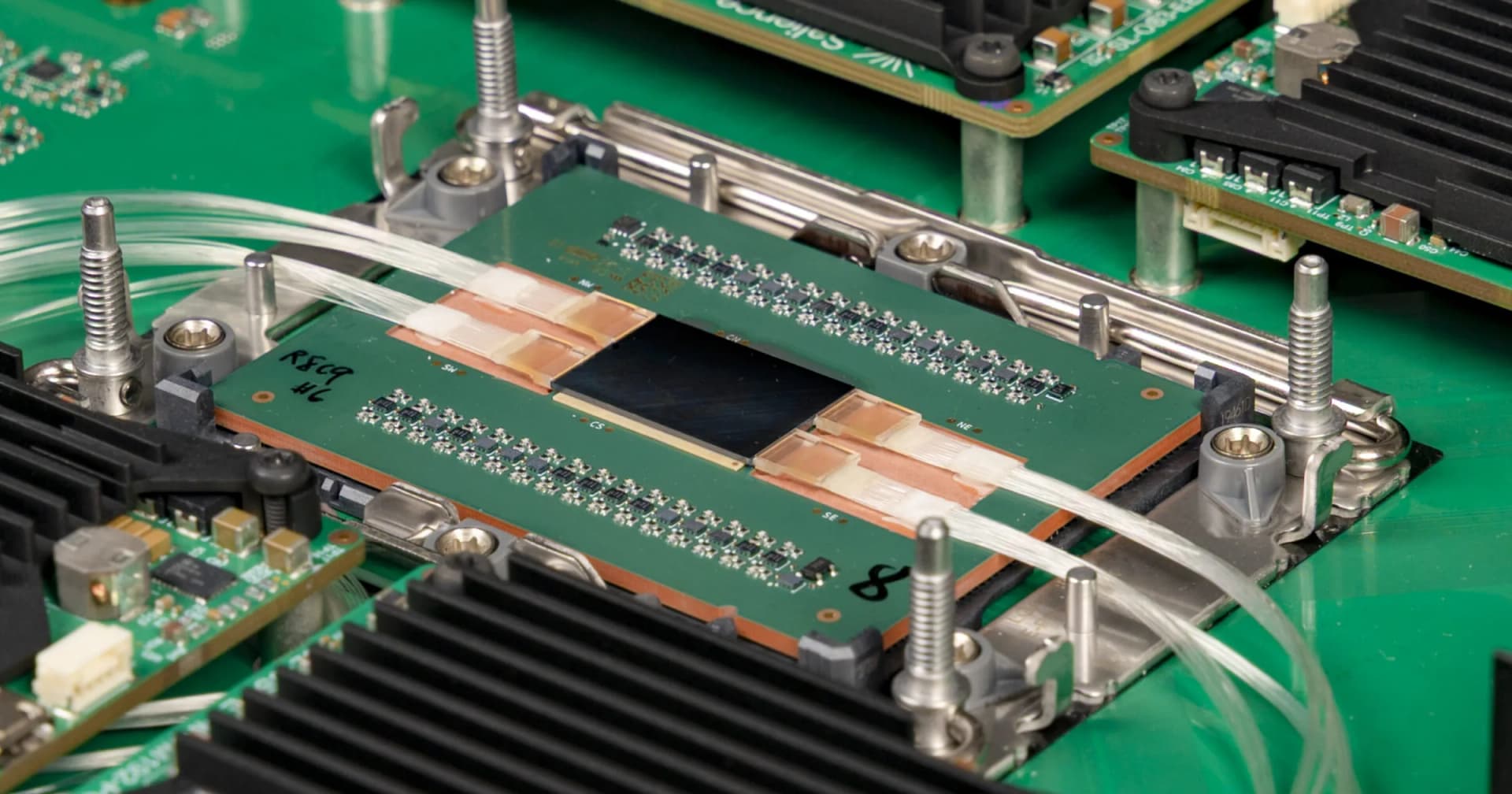
Salience Labs has raised $125 million to move data inside AI data centres with light instead of electricity. The Oxford photonics company, based in Milton, Oxfordshire, said the Series B was oversubscribed and led by Bullhound Capital, with the chip giants AMD and Intel both joining through their venture arms.
The round was announced on 14 October 2026. It is one of the larger cheques written into a British deep-tech company this year, and it lands in the hottest corner of the AI build-out: the plumbing that connects thousands of GPUs together.
What Salience Labs does
Salience builds an optical circuit switch, or OCS. In plain terms, it is a chip that routes beams of light between GPUs without ever turning them into electrical signals.
That matters because of a bottleneck most people never see. In a modern AI cluster, the hard part is often not the computing, it is moving data between chips fast enough to keep them busy.
Conventional switches convert an optical signal to electrical, process it, then convert it back to light. Each hop adds delay, heat and cost. Salience keeps the signal as light the whole way through.
The company calls its design an all-optical, fully integrated switch, built to connect thousands of GPUs across multiple racks for what the industry calls scale-up networking. It also points to proprietary optical amplification as its edge over rivals.
Why the timing is sharp
The pitch is landing because the numbers behind AI infrastructure are enormous. According to the research firm Dell'Oro Group, cumulative spending on AI back-end data-centre switches will approach $1 trillion between 2026 and 2030.
By the end of that period, scale-up networking is expected to make up more than half of that market. Salience is aiming straight at the part growing fastest.
It is also a power story. Every conversion between light and electricity burns energy, and energy is now the binding constraint on how big AI data centres can get. A switch that cuts those conversions is as much about electricity bills as it is about speed.
A real product, not a lab demo
Salience is further along than most photonics startups. At the ECOC 2026 conference it showed a working 64-port all-optical switch, which it describes as an industry first for silicon photonics OCS, after an earlier 32-port version was validated by the test firm Keysight.
The new money funds the next steps: volume manufacturing with Keysight Technologies and Tower Semiconductor, and larger 128-port and 256-port switches to come.
Part of the raise also pays for a push into the United States. Salience is opening a second office in Silicon Valley, closer to the hyperscalers and chipmakers that would buy its switches.
The founders and the Oxford roots
Salience was founded in 2021 on more than a decade of photonics research at the University of Oxford and the University of Münster in Germany.
Its chief executive and co-founder is Vaysh Kewada, a physicist with degrees from Imperial College London. She worked at McKinsey and was an entrepreneur-in-residence at Oxford Science Enterprises before starting the company.
Co-founder Dr Johannes Feldmann, a photonics physicist, helped build and test the early prototype.
"OCS will play a critical role in AI data centre networking," Kewada said. "As customers roll out optical links in their data centres, high-performance optical switches are needed, and Salience Labs has demonstrated a market-leading technology: a fully integrated on-chip solution."
Who is backing it
The investor list is the tell. Alongside lead investor Bullhound Capital, whose principal Callum Stewart joins the board, the round drew AMD Ventures and Intel Capital, the venture arms of two of the companies whose chips sit at the heart of AI data centres.
Also in were SBI Group, the trading firm Hudson River Trading and the government-owned British Business Bank. Existing backers Applied Ventures, Oxford Science Enterprises, Cambridge Innovation Capital and Silicon Catalyst Ventures returned.
Having both AMD and Intel on the cap table is unusual. It signals that the people who build AI silicon see optical switching as part of their own roadmap.
"AI infrastructure is increasingly being designed at rack scale, where networking has a direct impact on system performance," said Patrick Rundell, a director at AMD Ventures.
Srini Ananth, managing director at Intel Capital, put it more plainly. "Photonics is quickly becoming essential to scaling AI infrastructure," he said, singling out the company's integrated architecture and optical amplification.
What it means for UK tech
For Britain, this is the kind of deal the country keeps saying it wants. A university spinout turning a decade of lab research into hardware that the global AI industry needs, funded by strategic money from the US chip giants, and keeping its base in Oxfordshire.
It sits alongside a run of UK deep-tech and AI-hardware bets, from the chip designer Olix to the compute commitments drawing in players like NVIDIA. The pattern helps explain why the UK held second place globally for tech funding in 2025.
The hard part is still ahead. Salience has to turn a 64-port demo into high-volume products that hyperscalers will design into their networks, against entrenched switching suppliers and a wave of rival photonics startups.
But it now has the capital, the manufacturing partners and, in AMD and Intel, two backers who are also potential customers. In a market heading towards a trillion dollars, that is a strong hand to play.