
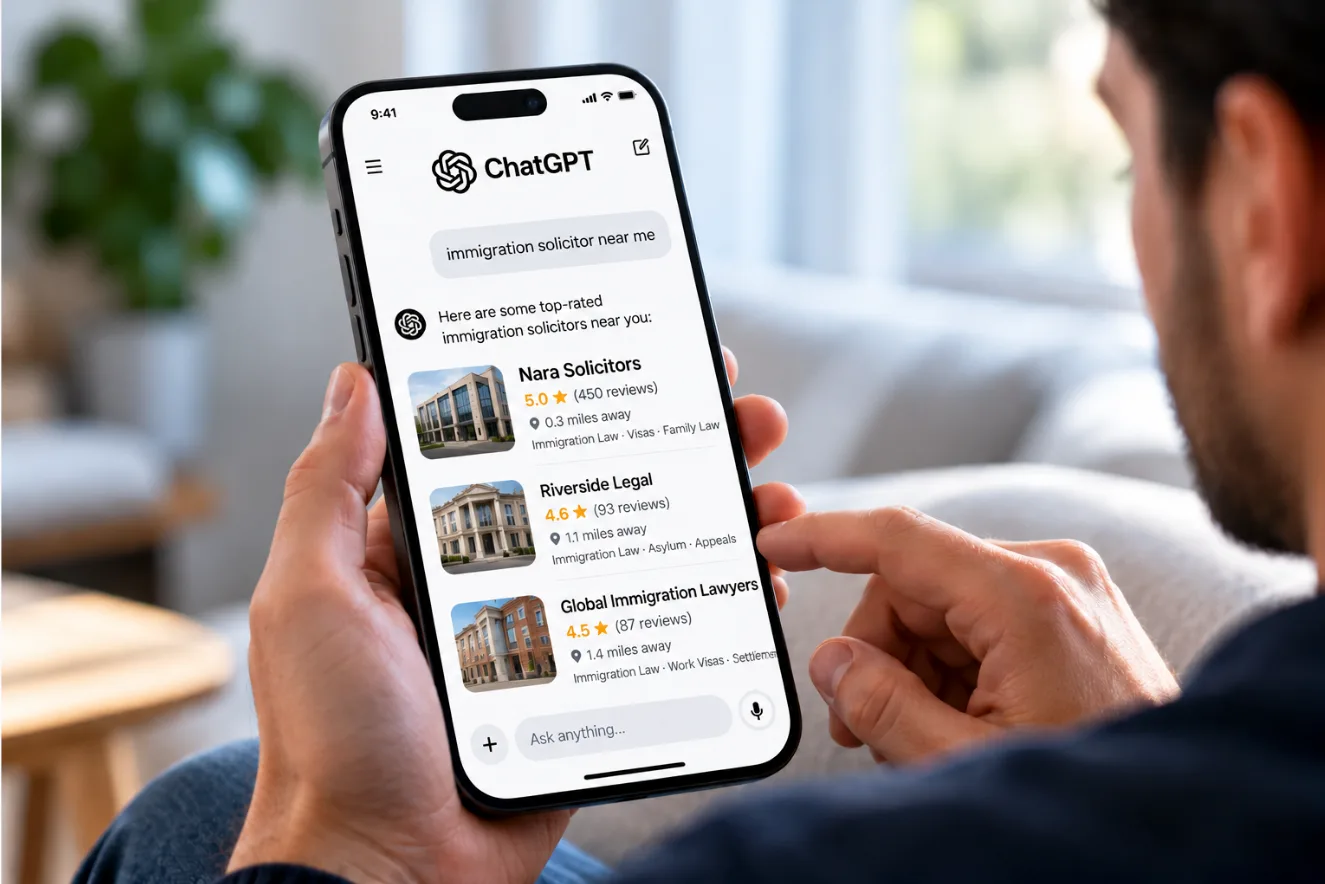
AI assistants sent 149% more visitors to UK retail websites in August 2026 than a year earlier, and those visitors now convert 20% better than shoppers from other channels, according to Adobe.
Search still takes the largest share of UK ad budgets, at £17.9bn in 2025, but Google now shows an AI summary on about 30% of UK searches.
That shift is why marketers now talk about AEO and GEO. Answer engine optimisation (AEO) is the work of getting your content picked as the direct answer to a question.
Generative engine optimisation (GEO) is getting your brand cited or recommended inside AI answers from ChatGPT, Gemini, Claude, Perplexity and Google's AI features.
These UK AI search statistics bring together the latest data on both, plus where UK digital marketing budgets are going. Most of it was published in 2026. Where a figure is global or US-only, we say so.
How many people in the UK use AI search?
About half of UK adults. Ofcom's Adults' Media Use and Attitudes report, published in April 2026, found 54% use AI tools such as ChatGPT, Copilot or Gemini. Among 16 to 24-year-olds, it is 79%.
A Which? survey of 4,189 UK adults found 51% use AI search tools for products, services and advice. Only 24% use them often, against 82% who use a traditional search engine often.
ChatGPT's UK growth has been steep. Ofcom's Online Nation 2025 report counted 1.8 billion UK visits to ChatGPT in the first eight months of 2025, up from 368 million in the same period of 2024.
AI has not replaced search. Similarweb's 2026 generative AI report found AI platforms are still about a fifth the size of search worldwide, and 95% of ChatGPT users still use Google.
Is ChatGPT losing ground to Gemini and Claude?
Yes, quickly. Similarweb data reported by PPC Land in June 2026 showed ChatGPT's share of global AI chatbot web traffic falling from 76.4% to 52.7% in a year.
Gemini rose from 8.9% to 27.3%, and Claude from 1.6% to 8.9%. Perplexity, often discussed as a Google rival, slipped to 1.3%.
Generative AI platforms averaged 9.5 billion web visits a month between June 2025 and May 2026, up 70% year on year. For GEO, the takeaway is simple: a brand that only shows up in ChatGPT answers is missing almost half of AI chatbot traffic.
How much traffic does AI search send to UK websites?
Traffic from AI is growing fast, and it converts well. Adobe's UK online spending report for January to August 2026 found AI-referred traffic to UK retail sites rose 1,439% between October 2024 and August 2026.
In August 2026 it was up 149% on a year earlier. In May 2026, AI visitors converted better than visitors from other channels for the first time.
By August 2026, AI-referred visitors converted 20% better than other traffic. They also spent 23% longer on site and viewed 13% more pages.
Adobe's survey of 2,014 UK consumers in March 2026 found 37% had used an AI assistant to shop. 34% of those AI shoppers had bought something without leaving the assistant.
Being recommended makes a measurable difference. Similarweb tracked what happened when ChatGPT recommended a brand rather than a rival. Skyscanner's visit rate rose from 3.4% to 9.5% of users, almost three times higher.
Are AI Overviews reducing clicks from Google?
Yes. Ofcom's Online Nation 2025 report found about 30% of UK searches now show an AI Overview, and 53% of UK adults say they often see them.
When they appear, fewer people click. An Ahrefs study of 300,000 keywords, published in February 2026, linked AI Overviews to a 58% lower click-through rate for the top-ranking page.
Show the data as a table
| Label | Value (%) |
|---|---|
| No AI summary | 15% |
| With an AI summary | 8% |
| Clicked a link inside the summary | 1% |
Pew Research Center's browsing study of US adults found people clicked a result on 8% of searches with an AI summary, against 15% without one. Only 1% clicked a link inside the summary.
This is the core AEO problem. The answer is shown on Google, so ranking first no longer guarantees the visit, a trend we covered in our guide to Google zero-click searches.
What does the CMA's new rule mean for AI search in the UK?
The UK now regulates how Google uses websites in its AI answers. In June 2026, the Competition and Markets Authority imposed a conduct requirement on Google Search under the Digital Markets, Competition and Consumers Act.
Google must give publishers a working way to stop their content being used in AI features such as AI Overviews, and to opt out of it being used to fine-tune AI models. It must also credit publisher content with clear links in AI results.
Google has nine months to put the changes in place, and must publish compliance reports every six months in the first year. Sarah Cardell, chief executive of the CMA, called it "a world-first requirement on Google's search services in the UK".
For UK businesses that publish content, this creates a real choice. Opting out protects your content, but it may also remove you from the AI answers where buyers now look.
Which websites do AI search engines cite most?
Community and video platforms. A March 2026 study by AI visibility tool Peec, covering about 30 million sources cited in US AI answers, ranked Reddit first, followed by YouTube, LinkedIn and Wikipedia.
The rest of the top ten were Forbes, G2, Yelp, Facebook, Medium and TechRadar. Each AI engine has its own favourites.
AI engineFive most-cited domains (US, March 2026)ChatGPTWikipedia, Reddit, Forbes, TechRadar, LinkedInGoogle AI OverviewsYouTube, Reddit, Facebook, LinkedIn, MediumGoogle AI ModeYouTube, Reddit, Facebook, LinkedIn, YelpPerplexityReddit, YouTube, LinkedIn, Wikipedia, G2GeminiReddit, YouTube, Wikipedia, Medium, PCMag and Forbes
Reddit's reach in the UK has grown with it. Fast Company reported in January 2026 that Reddit had overtaken TikTok as the UK's fourth most visited social platform, and that three in five British internet users now come across it.
Similarweb's US data adds a detail for content teams. 65% of URLs cited by ChatGPT sit two or three folders deep, so specific guides and product pages get cited. Yet 58.8% of ChatGPT referral traffic lands on a homepage.
Do UK consumers trust AI answers?
It depends on the question. UK surveys show fairly high trust in AI for finding and comparing options, and very low trust at the moment of buying.
In Adobe's March 2026 survey, 66% said they trust AI tools to give accurate product recommendations. In a CloudNine PR survey of 2,564 UK consumers, 52% of AI users said AI helps them find brands they would never have found otherwise.
Trust drops at the till. In a ThoughtSpot poll of 2,216 UK adults, run by YouGov, only 10.6% placed any trust in an AI suggestion at the point of purchase, and 53% actively distrusted AI product suggestions.
Doubts about independence run through the data. Only 30% of Which?'s AI search users thought the tools were independent or unbiased to a reasonable or great extent.
Ads could make this worse. 54% of CloudNine's AI users said they would trust AI recommendations less if adverts appeared in answers. Similarweb found ChatGPT ads already appear in 26% of US chats, with a 0.50% click-through rate.
Where do UK shoppers check an AI recommendation?
Mostly Google, reviews and the brand's own website. CloudNine found 79% of UK AI users would check other sources before trusting an AI recommendation, and only 4% would buy without checking.
Search engines came first at 46%, followed by online reviews at 43% and the brand's website at 32%. Six in ten said they were more likely to trust a recommendation backed by more than one source.
So GEO does not replace SEO or reviews. AI puts a brand on the shortlist, and Google results, review sites and the brand's own pages decide whether the buyer believes it.
How are UK marketers responding to GEO and AEO?
Faster than most. In an Optimizely survey of 1,000 marketers published in April 2026, 65% of UK marketers ranked GEO as a top priority, against 39% worldwide.
70% of UK marketers were already investing in content written for AI answers, against 54% worldwide. 43% said journeys where the buyer never clicks through to a website are already the norm, twice the global rate.
Confidence lags behind the spending. Only 42% were very confident that AI summaries describe their brand accurately.
Budgets are moving too. The IPA Bellwether report for Q3 2026 found a net 14.3% of UK companies raised their marketing budgets, the strongest upward revision in nine quarters.
PR budgets rose for the 13th quarter in a row, with a net balance of 15.3%. That fits the citation data: AI engines lean heavily on third-party sites, so being written about elsewhere now feeds AI visibility.
Investors are backing the tools. London-based Searchable, which tracks how brands appear in AI answers, raised £10.3 million in a round led by Headline.
Where are UK digital marketing budgets going in 2026?
Search is still the biggest channel, but social media is growing fastest. The AA/WARC Expenditure Report put UK ad spend at £46.7bn in 2025, up 6.4%.
Search took £17.9bn, up 5.8%, and social media £11.5bn, up 21%. Retail media, the ads sold by retailers such as Amazon and Tesco, reached £3.7bn.
The first quarter of 2026 kept the pace. UK ad spend rose 9.3% to £11.7bn, with search up 9.8% to £4.6bn and social media up 17.7%. AA/WARC now expects the UK market to pass £50bn for the first time in 2026, reaching £50.5bn.
Paid social still has a trust gap. Credos found 27% of UK adults trusted social media ads in 2025, and 25% trusted influencer ads, against 46% for TV.
What should UK founders do about AI search?
Start by measuring it. Set up AI assistants as a separate traffic source in Google Analytics, because Adobe's data shows these visitors convert better than average.
Write pages that answer one question clearly. That is the heart of AEO: a direct answer in the first lines, real numbers, prices and comparisons. ChatGPT tends to cite these specific pages rather than homepages.
Then fix the homepage anyway. Most ChatGPT referral traffic lands there, so it needs to say plainly what you sell, who it is for and what it costs.
Get mentioned where AI looks. Reddit, YouTube, LinkedIn, review platforms and trade press dominate AI citations, so a useful Reddit answer, a YouTube demo or a press feature can do more for GEO than another blog post.
Check how you appear in Gemini and Claude as well as ChatGPT. Ask each one the questions your buyers ask, and note who gets recommended instead of you.
Keep reviews genuine. Buyers check reviews after an AI suggestion, and fake reviews have been illegal in the UK since April 2025, with fines of up to 10% of global turnover.
Do not abandon search. Google still drives the largest share of UK ad spend and nearly every ChatGPT user still uses it. Our round-up of UK startup statistics for 2026 has more on how British startups find customers.
About the data
Each figure comes from a named study. They use different methods and samples, so compare them with care.
StudyCoverageDateAdobe Digital Insights (Analytics data)UK retail sitesJanuary to August 2026Adobe consumer survey (Advanis)2,014 UK consumersMarch 2026Ofcom Adults' Media Use and Attitudes7,533 UK adults aged 16+Fieldwork Sept to Nov 2025, published April 2026Ofcom Online NationUK adultsPublished December 2025Which? (Yonder)4,189 UK adultsFieldwork September 2025, published December 2025Similarweb generative AI reportWorldwide and US web dataPublished October 2026Similarweb AI traffic shares (via PPC Land)Worldwide web trafficData to May 2026Ahrefs300,000 keywordsPublished February 2026Pew Research Center900 US adultsPublished July 2025CMA conduct requirement on GoogleUKJune 2026Peec citation study30 million US AI citationsMarch 2026TLF Research for CloudNine PR2,564 UK consumers, 1,989 AI usersPublished June 2026YouGov for ThoughtSpot2,216 UK adultsPublished September 2026Optimizely1,000 marketers worldwide, including the UKPublished April 2026IPA BellwetherUK marketing budget panelQ3 2026, published October 2026AA/WARC Expenditure ReportUK ad spend2025 and Q1 2026, published April and July 2026Credos Trust TrackerAround 2,000 UK adults a year2025
Several studies come from companies that sell marketing or analytics tools, including Adobe, Similarweb, Ahrefs, Peec, CloudNine PR, ThoughtSpot and Optimizely. The Similarweb, Peec, Ahrefs and Pew figures are global or US-based, as marked.
Bizztor tracks what works for UK founders every week. Follow Bizztor on LinkedIn for new data as it lands.