

Most UK lawyers now use AI at work, and a growing minority could not do their job without it.
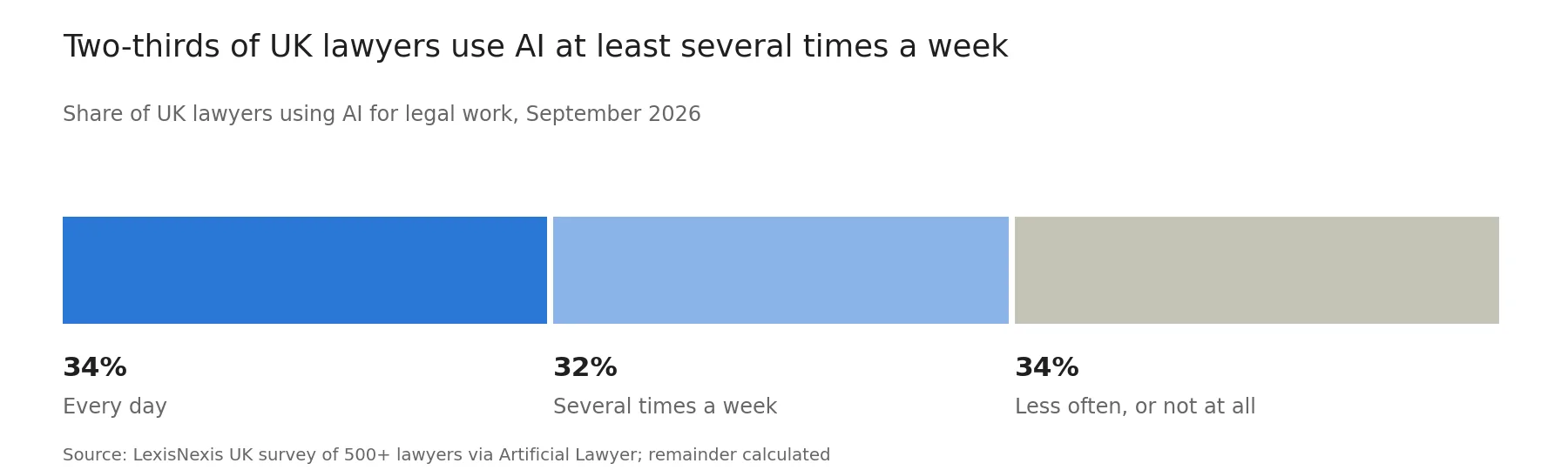
LexisNexis found in September 2026 that 34% of UK lawyers use AI for legal work every day and another 32% several times a week.
At large firms, 15% of lawyers said they now depend on it (Artificial Lawyer). Four of the five Magic Circle firms have publicly chosen an AI platform. The Solicitors Regulation Authority has licensed two AI-led law firms. The High Court and the Upper Tribunal have both referred lawyers to their regulators for citing cases that AI invented.
Those facts leave two questions open for UK firms. Who keeps the money when a task that took a day takes ten minutes? And who answers for it when the output is wrong?
This article looks at both for England and Wales, using published surveys, court and tribunal decisions and government documents. Where there is no UK figure, a global one is used and labelled. It is for law firm partners, in-house lawyers, trainees and newly qualified solicitors, and people building legal tech in the UK.
How many UK lawyers use AI?
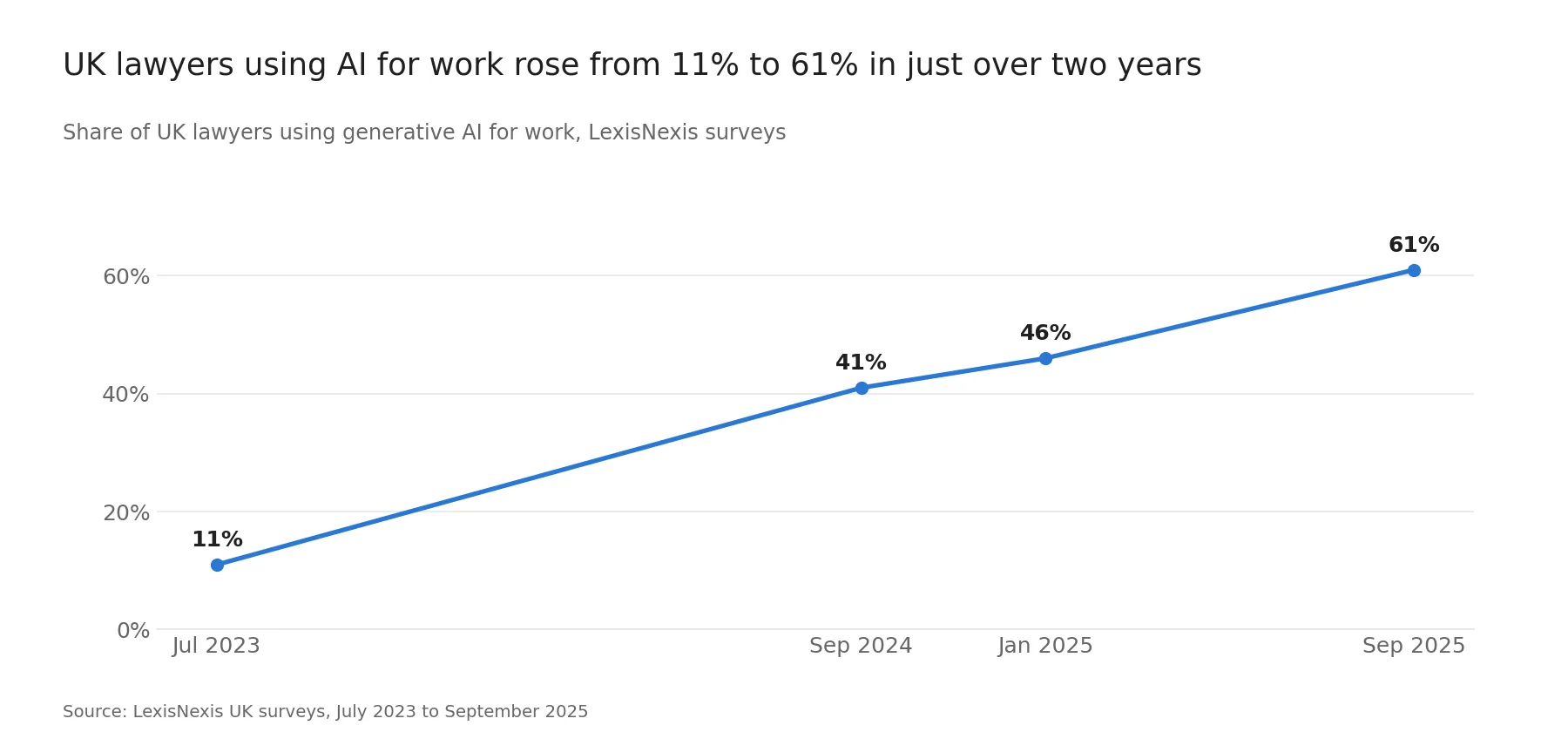
UK lawyers moved from trying AI to relying on it in about three years. In LexisNexis's surveys of the UK profession, generative AI use for work rose from 11% in July 2023 to 61% by autumn 2025 (LexisNexis UK, 2024; LexisNexis, The AI culture clash).
In-house teams moved first: AI activity in UK corporate legal teams rose from 47% to 74% during 2024.
Strategy has not kept pace. In the autumn 2025 survey only 17% of UK lawyers said AI was embedded in their firm's strategy and operations, and two-thirds called their organisation's AI culture slow or non-existent.
Lawyers were split almost evenly between purpose-built legal tools such as Lexis+ AI (51%) and general tools such as ChatGPT alone (49%), and 77% remained concerned about inaccurate output (Artificial Lawyer).
That split matters for confidentiality. A lawyer who pastes client documents into a consumer chatbot may be handing privileged material to a third party. The Upper Tribunal considered the effect of public AI tools on confidentiality and privilege in UK v Secretary of State for the Home Department [2026] UKUT 81 (IAC) (Practical Law).
There is no UK figure for unapproved use, but Thomson Reuters found globally that 34% of law firm professionals use AI their organisation has not sanctioned (Thomson Reuters).
Which AI platforms are UK firms using?
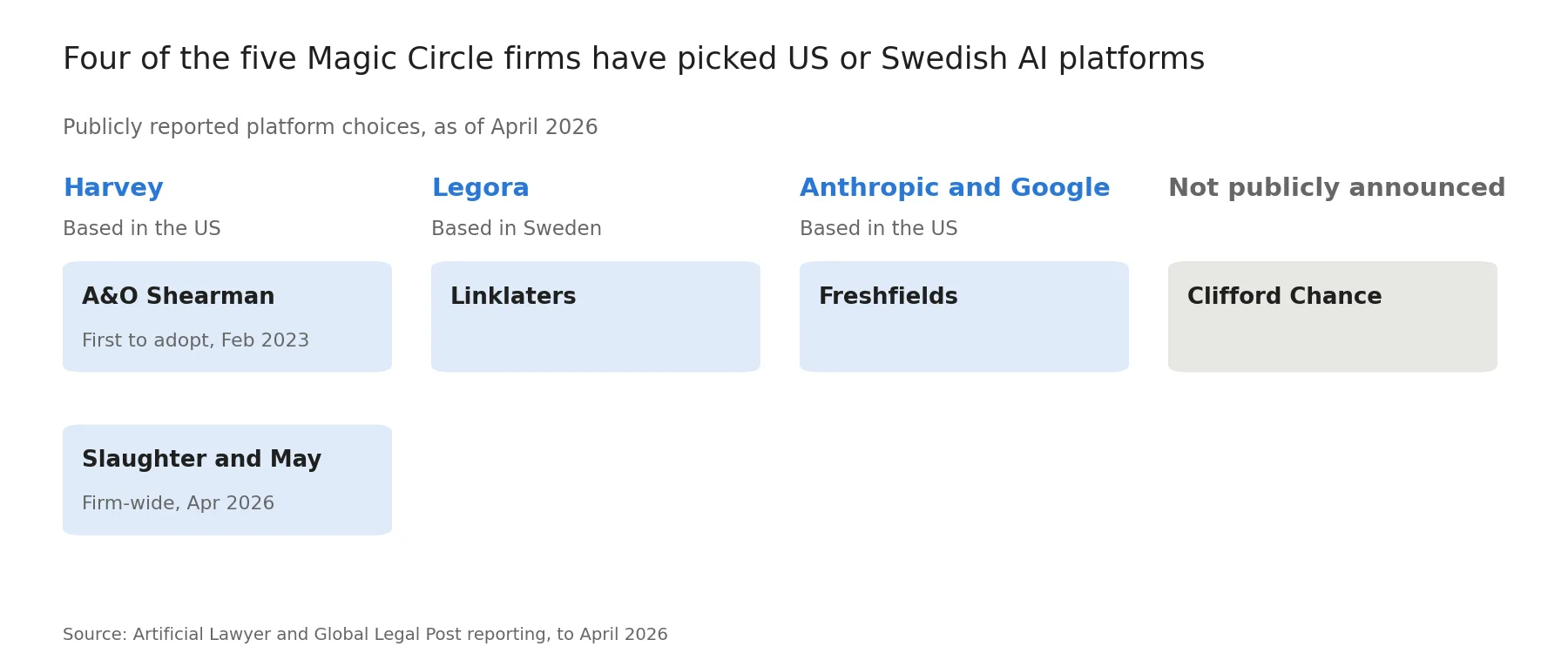
The Magic Circle has now picked its platforms, and none of them is British. A&O Shearman, then Allen & Overy, became the first Magic Circle firm to use a generative AI tool when it adopted Harvey in February 2023.
Linklaters chose Legora, Freshfields signed with Anthropic and Google, and Slaughter and May adopted Harvey across all practice areas in April 2026 (Artificial Lawyer). Harvey also lists CMS and Burges Salmon among recent adopters (Global Legal Post).
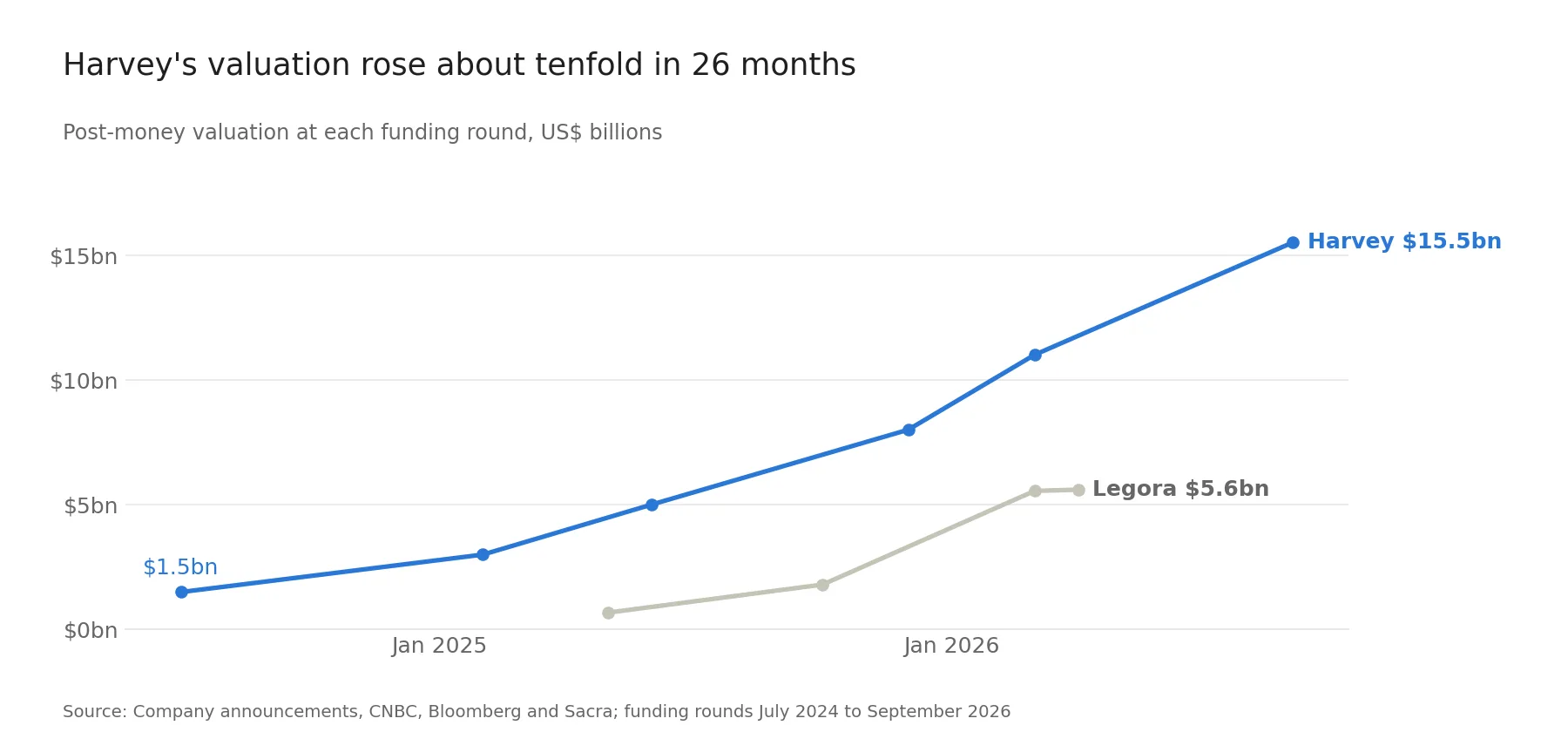
Those vendors are very well funded. US-based Harvey raised $550 million at a $15.5 billion valuation on 9 September 2026 (Harvey). Swedish rival Legora reached $5.6 billion in April 2026, with Barclays among its new investors, and says it now serves more than 1,000 organisations (Legora).
The same investor appetite runs through the wider AI market, from OpenAI's record $110 billion funding round to London startups building agents for specific industries.
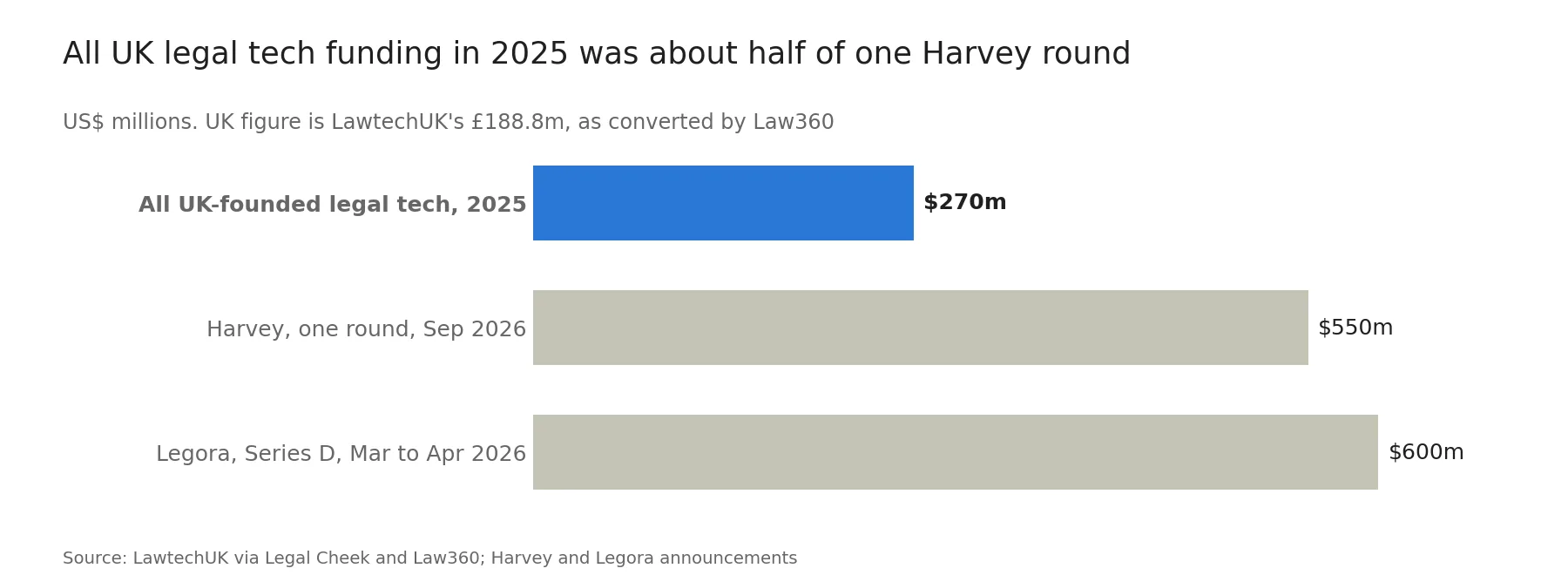
UK-founded legal tech raises a fraction of that. LawtechUK, the government-backed programme, reported a record £188.8 million invested in UK legal tech in 2025, up 35% on 2024 (Legal Cheek).
Law360 put that at about $270 million, roughly half of Harvey's single September round (Law360). Most UK money went to contracts and documents, risk and matter management. Only 17% of UK legal tech activity in the first half of 2025 was aimed at consumers (Legal Futures).
The government still backs the domestic sector: Justice Secretary David Lammy committed three more years of funding for LawtechUK (LawCareers.net). But the platforms that many large UK firms now run legal work through are built and priced in the US and Sweden.
Firms that move their work onto them will be negotiating renewals with a small number of very well-funded suppliers.
Is AI bringing legal fees down?
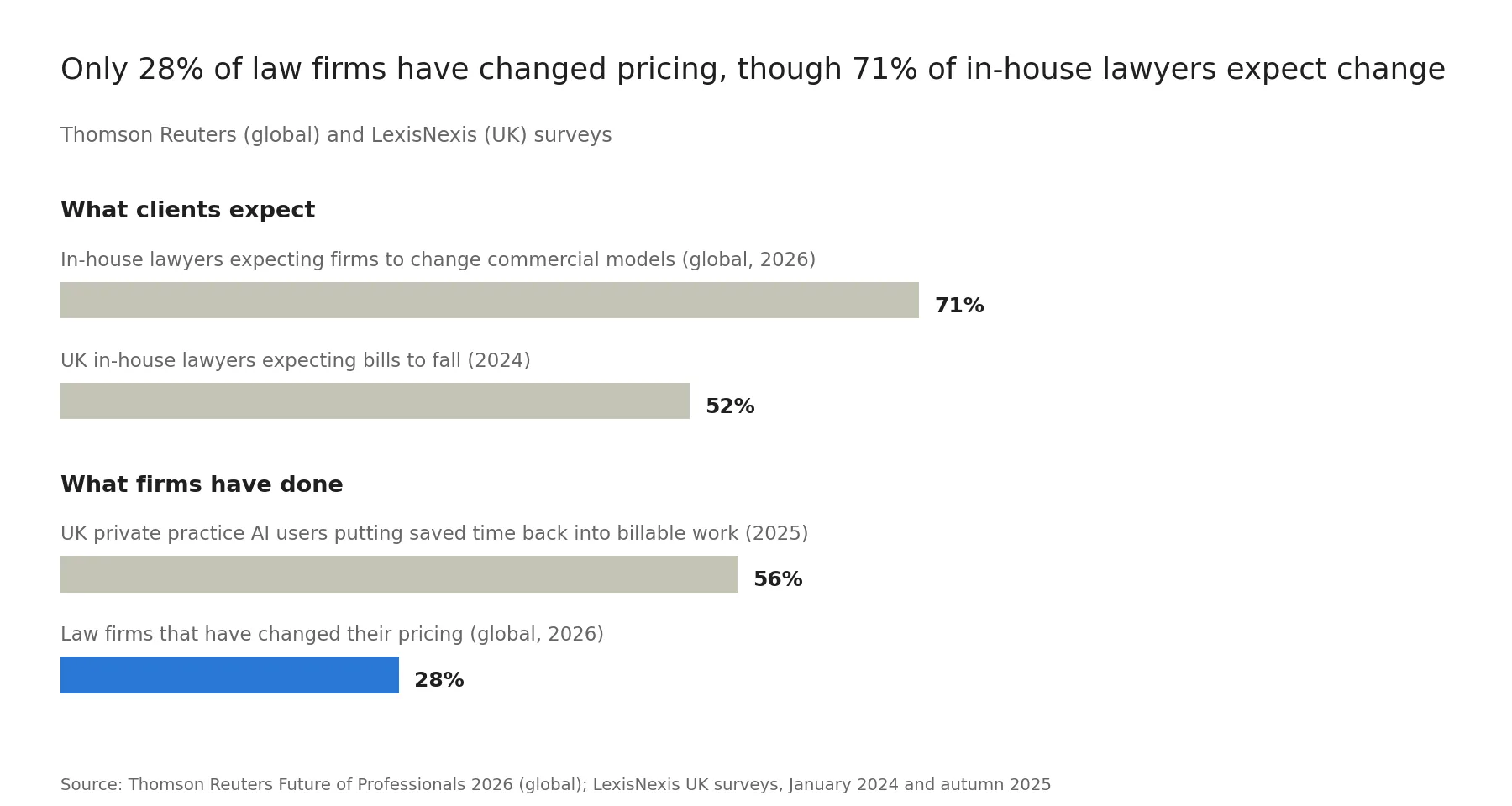
UK in-house teams have expected cheaper bills for some time. In LexisNexis's January 2024 UK survey of more than 1,200 legal professionals, 52% of in-house respondents said they would expect bills to fall because of generative AI (LexisNexis UK).
Firms have mostly recycled the time instead. LexisNexis found in autumn 2025 that 56% of UK private practice lawyers using AI put the time saved back into billable work. One law firm leader in that survey predicted that clients will expect lower fees because AI delivers results faster, pushing the market towards fixed fees and retainers (Artificial Lawyer).
Global data shows clients starting to act. Thomson Reuters' 2026 research across 46 countries, including the UK, found that 71% of in-house lawyers expect outside firms to change their commercial models as AI use grows. Only 28% of firms have changed their pricing. Nearly a third (32%) of in-house teams are already reconsidering firm relationships, or will within 12 months, if they see no AI-enabled value (Thomson Reuters, 2026 Legal Report).
AI-led firms the SRA has authorised
England and Wales now has regulated firms built around AI from day one. In May 2025 the Solicitors Regulation Authority authorised Garfield.Law, a debt recovery firm for claims up to £10,000 whose letters start at £2.
The SRA set conditions: the system cannot propose case law, it acts only with client approval, and named solicitors remain accountable (SRA; Law Gazette). In August 2026 the SRA authorised a second, LawFairy. It describes itself as a technology-only practice built on a deterministic legal model, and it passes complex matters to traditional firms with a structured case file (Global Legal Post).
Garfield. Law prices each step of a claim separately, starting at £2.
How UK courts are dealing with fake AI citations
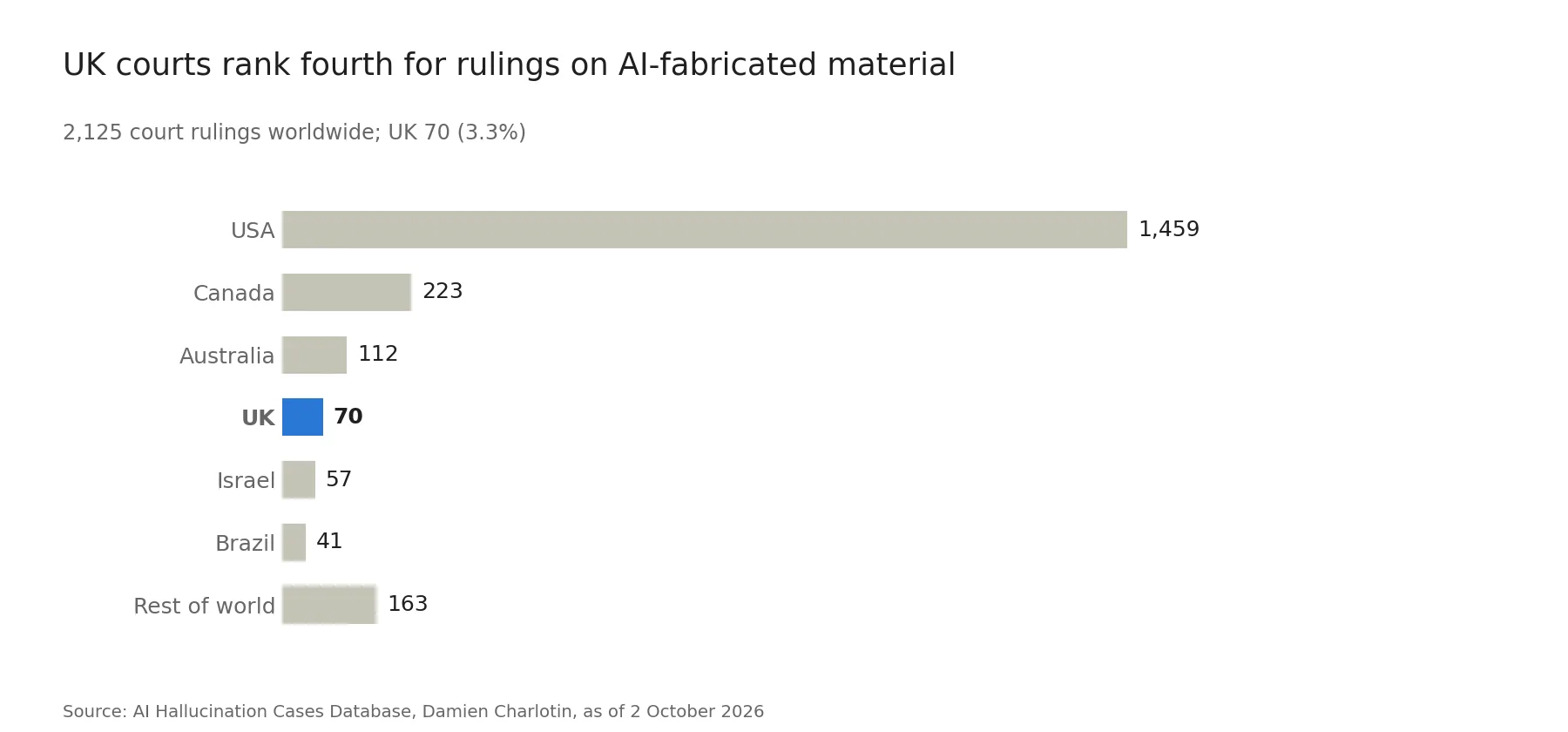
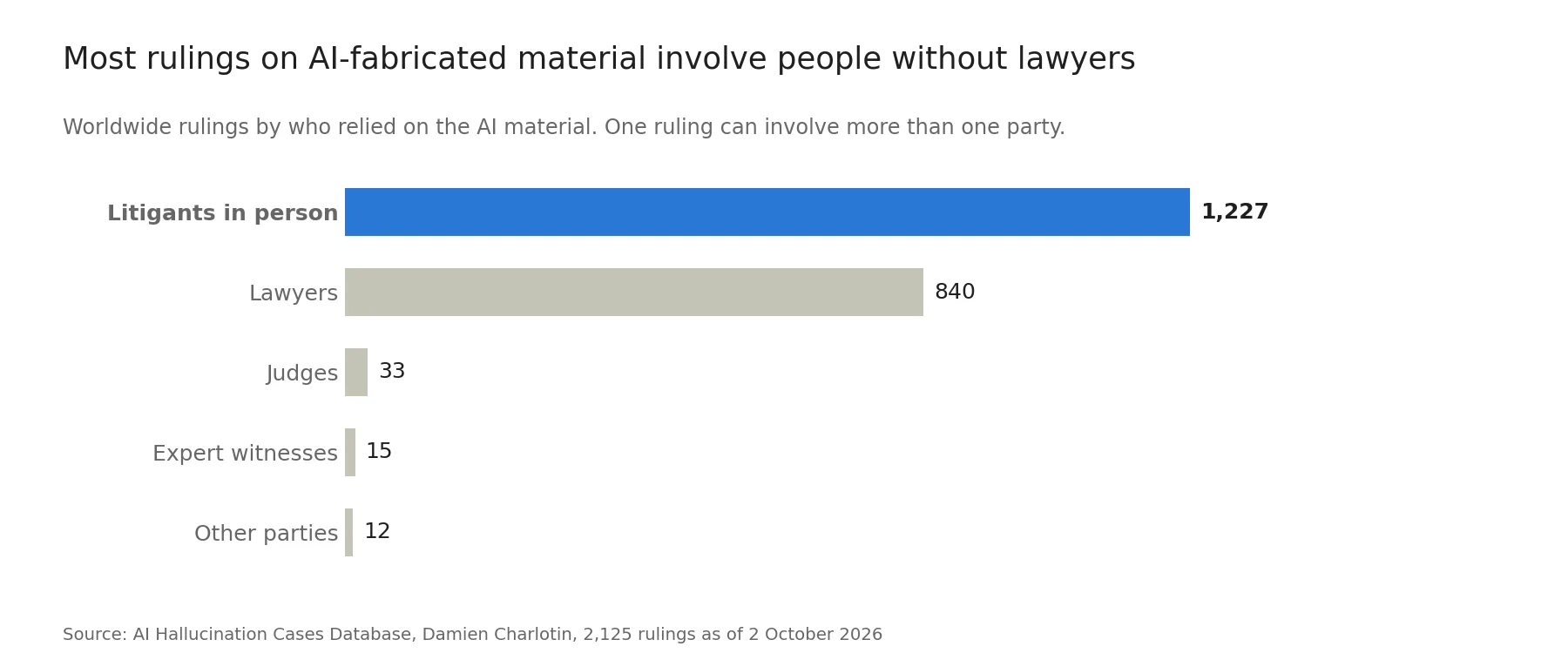
UK courts and tribunals have now issued 70 rulings involving AI-fabricated material. That figure comes from the public database kept by Damien Charlotin, a research fellow at HEC Paris, which counted 2,125 such rulings worldwide on 2 October 2026 (AI Hallucination Cases Database). It records only cases a court has addressed, so the number of fabricated citations actually filed is higher.
Most fabrications are fake case law, but a large share are real cases misrepresented or quoted with words they do not contain. Those are harder to catch with a simple "does this case exist" check.
The leading UK authority is R (Ayinde) v London Borough of Haringey; Al-Haroun v Qatar National Bank [2025] EWHC 1383 (Admin). Dame Victoria Sharp, President of the King's Bench Division, and Mr Justice Johnson decided it on 6 June 2025 (Judiciary of England and Wales).
In Al-Haroun, 18 of 45 cited authorities did not exist, and the citations had come from the client's own AI research, which the solicitor adopted. The court declined to start contempt proceedings but referred lawyers to their regulators and said that its restraint set no precedent (Hausfeld).
Immigration appeals have produced several reported decisions. In MS (Bangladesh) [2025] UKUT 305 (IAC), the Upper Tribunal referred a barrister to the Bar Standards Board after he relied on a Court of Appeal case, "Y (China)", that ChatGPT had invented. Asked for a copy of the judgment, he handed in internet print-outs instead (Free Movement). In UK and R (Munir) [2026] UKUT 81 (IAC), three Upper Tribunal judges reported a considerable increase in fictitious authorities in the second half of 2025. They said the tribunal's limited resources could not be spent on representatives who put false material before it (Upper Tribunal decision). A supervising solicitor in one of the joined cases was referred to the SRA (EIN).
Judges now have guidance on spotting it. The judiciary's AI guidance for judicial office holders, updated on 31 October 2025, lists unfamiliar citations, sometimes from US cases, as a sign that submissions were produced with AI (EIN).
Every one of these cases involved a person who signed a document without checking the authorities in it.
What the UK government and regulators have done
The Ministry of Justice is using AI across the justice system and has left lawyers' own use to existing professional rules. It published its three-year AI Action Plan for Justice on 31 July 2025, covering courts, tribunals, prisons and probation, with a Justice AI Unit led by a Chief AI Officer (GOV.UK).
Judges in England and Wales now have Microsoft Copilot on the eJudiciary platform. The Lord Chancellor described the MoJ in February 2026 as one of the fastest-growing Copilot users in government (Nuffield Foundation).
The Civil Justice Council, under Lord Justice Birss, consulted from 17 February to 14 April 2026 on whether court rules should govern AI in court documents. It proposed that lawyers declare AI was not used to generate the content of trial witness statements, and that experts disclose AI use in their reports. It favoured no new rules for skeleton arguments that a named lawyer signs (HSF Kramer).
Its June 2026 update indicated a preliminary view against broad formal intervention for lawyers (Civil Litigation Brief).
So far the UK has relied on existing law. The UK Jurisdiction Taskforce, whose drafting team was chaired by Matthew Lavy KC, concluded in July 2026 that contract, negligence, misrepresentation and defamation can deal with most AI-related harm. It found that AI has no legal personality in English law, so nobody can be vicariously liable for an AI system itself.
It also expects contract to remain the main way to allocate AI risk (SCL). That is a more conservative position than the Law Commission's July 2025 paper, which floated, without recommending, the option of giving some AI systems legal personality to close liability gaps (Legal Futures).
Parliament has not filled the space. A dedicated AI Bill was expected in the May 2026 King's Speech but has not appeared, and the next King's Speech is not expected before late 2027 (Lewis Silkin). For lawyers, the practical rules therefore come from the SRA, the Bar Standards Board and the courts.
UK firms with EU clients or offices still face the EU AI Act. AI used to assist judicial authorities sits in the Act's high-risk annex. The Digital Omnibus, in force since 27 July 2026, moved those duties from 2 August 2026 to 2 December 2027 (Hogan Lovells; Cloud Security Alliance).
Can AI reach people who cannot afford a lawyer?
Many people in England and Wales who need legal help never get it. The Legal Services Board and the Law Society surveyed 17,668 adults for their 2023 Legal Needs Survey. It found that 66% of people in England and Wales had a legal issue in the previous four years. Of those with a legal need, 32% were left with an unmet need, and the most common reason was that they could not get professional help (Legal Services Board). Unmet need was highest for family issues, at 40%. The figure was 31% in 2019, so it did not improve between the two surveys.
Low-cost AI services such as Garfield.Law are aimed at this gap. A small business sending a £2 chaser letter through Garfield.Law would probably not have paid a solicitor to send it.
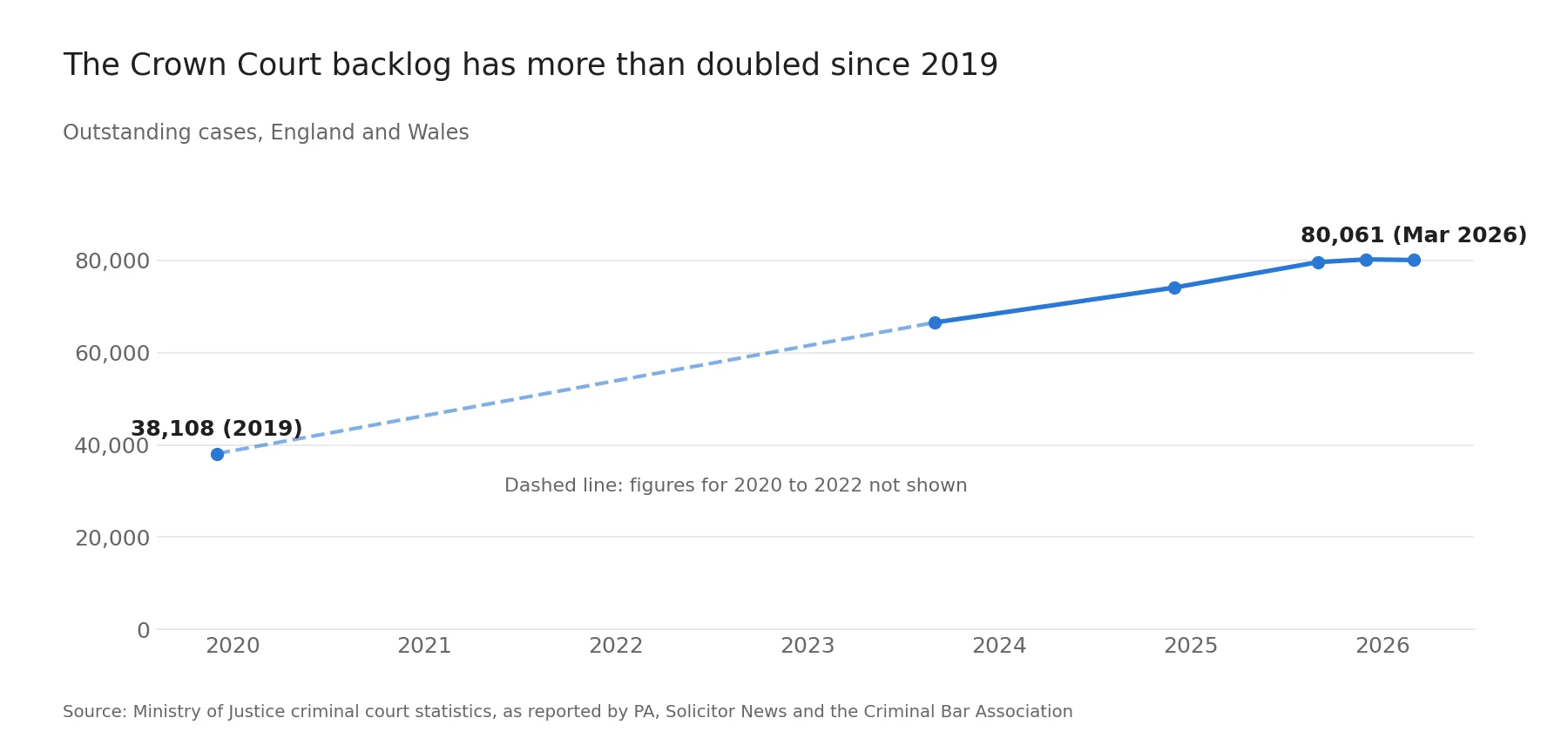
The courts are the constraint. The Crown Court backlog in England and Wales stood at 80,061 cases on 31 March 2026, more than double the 2019 level. The magistrates' courts held a record 370,722 open cases (Criminal Bar Association; Solicitor News). AI has not reduced that queue yet.
AI may also add to it. Worldwide, 1,227 of the 2,125 rulings in Charlotin's database involve litigants in person, against 840 involving lawyers. People without lawyers can now produce filings that look professional.
Courts then spend time checking authorities that do not exist. Any access-to-justice gain from consumer AI depends on court systems having tools to triage that volume.
What AI means for trainees and junior lawyers
AI has not yet cut trainee numbers in any meaningful way. Legal Cheek's September 2026 data across more than 100 leading firms shows training contract numbers down only 2% for 2027. Its own analysis points to the growth of solicitor apprenticeships as the more likely cause (Legal Cheek).
The wider UK jobs debate is sharper: Rishi Sunak has argued AI is holding UK hiring flat across many sectors.
The bigger change is to how juniors learn. Document review, first drafts and research summaries were how trainees built judgement, and those are the tasks AI does best.
In Thomson Reuters' 2026 global research, 48% of legal professionals were concerned about AI's effect on how independent judgement develops. Respondents expected the time it takes to reach trusted judgement to stretch by almost two years (Thomson Reuters).
Lawyers now also choose employers partly on their AI tools. Globally, Thomson Reuters found that 24% of law firm professionals would refuse a job offer from a firm without professional-grade AI (Thomson Reuters, law firm insights).
LexisNexis found that 18% of UK private practice lawyers would consider leaving a firm that failed to invest in AI. For trainees who want to build those skills themselves, there are free agentic AI courses covering automation and AI agents.
Firms are therefore caught between two pressures. Trainees want the tools, but unrestricted use can leave them signing off work they could not have produced themselves, and unchecked sign-off is how fabricated authorities reach a court.
The UK market is splitting.
Large firms are buying US and Swedish platforms, while the SRA has shown it will license narrow, AI-led firms with clear guardrails.
The unmet need among individuals and small businesses, 32% of people with a legal need in England and Wales, has few well-funded competitors. Consumer products made up only 17% of UK legal tech activity in the first half of 2025.
Build for auditability from day one: the SRA barred Garfield.Law's system from proposing case law. If you sell into the EU, plan for the AI Act's high-risk duties from 2 December 2027.
This article is for general information only and is not legal advice. Figures, rules and court decisions are as reported up to 4 October 2026, so check the linked sources and speak to a qualified solicitor before acting on anything here.