
Poor communication is the single biggest reason people complain about their lawyers in England and Wales, and most of it happens after the client has already said yes.
The Legal Ombudsman's latest figures show poor communication in 24% of complaints and delay in another 22%. Together, that is almost half of everything it receives.
Firms spend money and effort winning the consultation. Then the client signs up, the file goes into a queue, and the client hears nothing for a week.
That gap is where trust is won or lost. This guide sets out what the data says about it, and a simple method any firm can use to close it.
What happens in a client's head after the consultation
The client has just made a big decision. They have chosen your firm over others, agreed to pay, and handed over a problem that often affects their home, family, job or right to stay in the country.
At that moment they are looking for proof they chose well. Every hour of silence gives them room to doubt it.
Speed alone is not the point. A fast first reply tells the client three things at once: you remember them, their matter is moving, and someone is in charge of it.
What the UK data says about communication
The clearest evidence comes from complaints. In 2025/26, the Legal Ombudsman received 14,259 new complaints, up 37% on the year before.
Poor communication was the most common complaint type, and also the most common reason a complaint was upheld.
When the Ombudsman looked into complaints, it found evidence of poor service in 72% of them. The rate was highest in wills and probate and in residential conveyancing.
The Ombudsman's own reading of the data is blunt. It says communication problems often sit behind complaints about delay, and that clients' expectations of updates can differ from what firms think is reasonable.
The cost is real. The Ombudsman awarded £3.7m in remedies in 2025/26. Fee refunds or reductions were ordered in 29% of investigated complaints, averaging £3,520 each.
Most unhappy clients never complain
Complaint figures only show the clients who speak up. The bigger risk is the ones who stay quiet.
The Legal Services Consumer Panel's 2026 Tracker Survey, based on 3,802 people who used legal services in the previous two years, found that 40% of dissatisfied clients did nothing about it, up from 28%. Formal complaints to the firm fell from 20% to 14%.
More than a quarter, 27%, said they would not complain to their provider because they were worried about how the firm would react.
Those clients do not show up in any complaints log. They simply do not come back, and they do not recommend you.
Why this decides future work
Repeat and referred clients are a large share of how people choose a lawyer. In the Panel's 2025 survey, having used the provider before, or having a family member who had, was the top reason for choosing a legal expert, at 19%.
Satisfaction overall is high. The 2026 survey put satisfaction with service at 90%, the first time it has reached that level.
That makes the gap between good and average firms smaller, and the small things more visible. A firm that replies fast and keeps clients informed stands out because most firms are already "fine".
How fast clients expect a reply
The UK regulators do not set a response deadline. The best data on expectations comes from the US, from Clio's Legal Trends research, so treat it as a guide and not a UK rule.
Clio surveyed 2,000 consumers and found 79% expected a response within 24 hours.
Show the data as a table
| Label | Value (%) |
|---|---|
| Within 1 hour | 10% |
| Within a few hours | 24% |
| Within 24 hours | 45% |
| Within 72 hours | 5% |
Firms think they meet that. In the same research, 89% of legal professionals said they respond within 24 hours. When Clio tested this with mystery-shopper emails in 2024, only 33% of 500 firms replied at all, down from 40% in 2019.
That test was about new enquiries, not signed clients. But it shows how wide the gap can be between what firms believe and what clients experience.
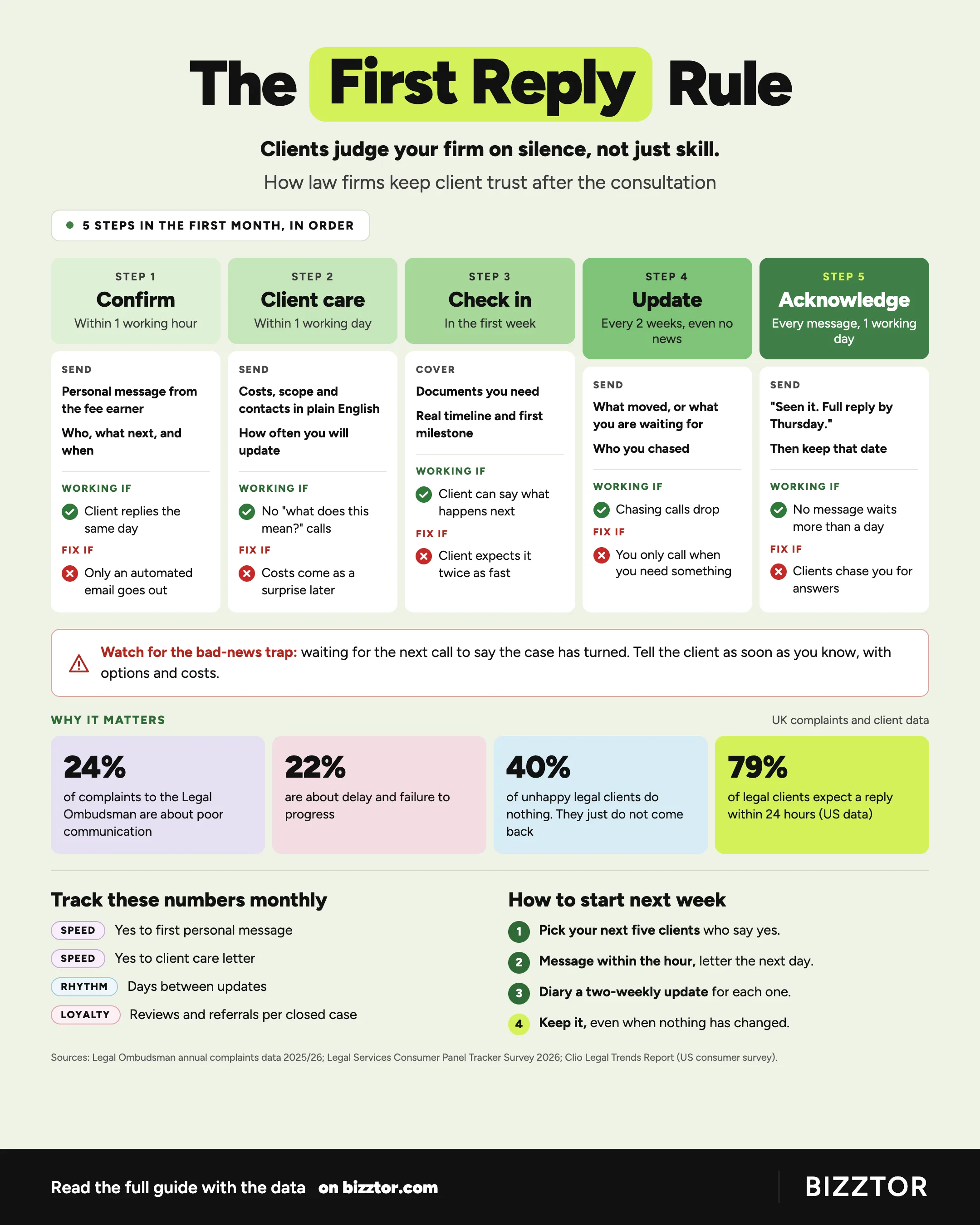
The First Reply Rule: a 5-step method for the first month
The order matters. Each step answers the question the client is most likely to have at that point.
The time frames below are Bizztor's suggested standards, not regulatory rules. Adjust them to your practice area and team size.
1. Confirm within one working hour of the yes
Send a short personal message from the fee earner, not a system email. Say who is handling the matter, what happens next and when they will next hear from you.
Hi Sarah, thank you for choosing us. I'll be handling your case, with support from my colleague James. You'll receive our client care letter by tomorrow afternoon. If anything comes up before then, reply here or call me on 020 0000 0000.
2. Send the client care letter within one working day
This is where most of the trust is built or lost. The SRA requires firms to give clients information in a way they can understand, and the best possible information about likely costs, both at the start and as the matter progresses.
The SRA's own guidance on client care letters suggests short sentences, bite-size sections and a focus on what matters to that client. Add one more thing most letters leave out: how often the client will hear from you, and how.
3. Hold a first-week check-in
A 10 to 15 minute call in the first week covers what the letter cannot. Walk through the documents you need, the realistic timeline and the first milestone.
This is also the moment to correct expectations. The Legal Ombudsman found home buyers expected a purchase to take about 8.5 weeks, when one study put the 2024 average at 17 weeks. The same kind of gap exists in most areas of law.
4. Set an update rhythm and keep it, even with no news
Agree a rhythm with the client, such as every two weeks, and stick to it. The Ombudsman's advice to conveyancers is that short, predictable updates, even with nothing new to report, can improve satisfaction and cut incoming queries.
No change this week. We are still waiting for the Land Registry, which we chased on Tuesday. We expect to hear by the 20th and will update you either way.
That message takes two minutes. It stops a worried phone call, and it is evidence of good service if a complaint ever arises.
5. Acknowledge every message within one working day
Not every question can be answered in a day. Every message can be acknowledged.
Thanks, I've seen this. I need to check one point with the other side and will come back to you properly by Thursday.
When the case is not going the client's way
Fast communication matters most when the news is bad. A client who hears early that their case is weaker than hoped can still make good decisions about cost and next steps.
The SRA expects firms to tell clients in a timely way about risks, progress and costs, including whether the likely cost and risk still make the claim worth pursuing. The Law Society's compliance advice is plain: give clients bad news as well as good.
Delivering it well comes down to a few habits:
Tell the client as soon as you know, not at the next scheduled update.
Explain what changed and why, in plain English.
Set out the realistic options, with the likely cost of each.
Put it in writing after any call, so the client can reread it.
I want to update you before our next scheduled call. The other side's evidence on the contract dates is stronger than we expected. I still think we have a case, but the chance of winning outright is lower. Here are your three options, with what each is likely to cost.
Clients often forgive a weak case. They rarely forgive finding out late.
From satisfied client to advocate
Loyalty is built at the end of the matter as much as the start. Three steps make the difference.
First, close properly. Send a short summary of what was achieved, what the client should keep, and any dates they need to watch, such as a visa expiry or a lease break.
Second, ask for feedback while the matter is fresh. A client who had a good experience is most likely to leave a review in the first few days after completion.
Third, stay in touch for real reasons. A note when the law changes in a way that affects them is worth more than a newsletter.
Systems that keep response times short
Good intentions fade when a fee earner has 60 open files. The firms that do this well build it into their systems instead of relying on memory.
Practice management software can set reminders for each update date. A shared inbox stops messages getting stuck when one person is away. A client portal lets clients check progress without calling.
AI can now draft routine updates from the file for a fee earner to check and send. Bizztor's guide to the best AI tools for UK law firms compares the main options, and its analysis of how AI is changing UK legal practice covers the risks. Never let AI send client updates without a person reading them first.
The first reply often starts before the consultation, on your website or contact form. Firms that want enquiries, booking and follow-up joined up from the first click often bring in a digital marketing agency for law firms to set it up.
How to measure your response time
What gets measured gets fixed. Track five numbers for every new client, monthly:
Time from the client's yes to your first personal message.
Time from the yes to the client care letter.
Average days between updates on open matters.
Share of messages acknowledged within one working day.
Review and referral rate from closed matters.
Start with the first two. They are the easiest to fix and they shape everything after.
Firms growing their team can use the same approach Bizztor sets out for scaling a service business: turn what your best fee earner does by instinct into a written standard everyone follows.
Where to start next week
Pick the next five clients who say yes. Send each one a personal message within the hour, and the client care letter the next day.
Then put a two-weekly update in the diary for each, and keep it even when nothing has changed.
That is the First Reply Rule in practice. It costs a few minutes per client, and the data says it is where most complaints, and most referrals, begin.