
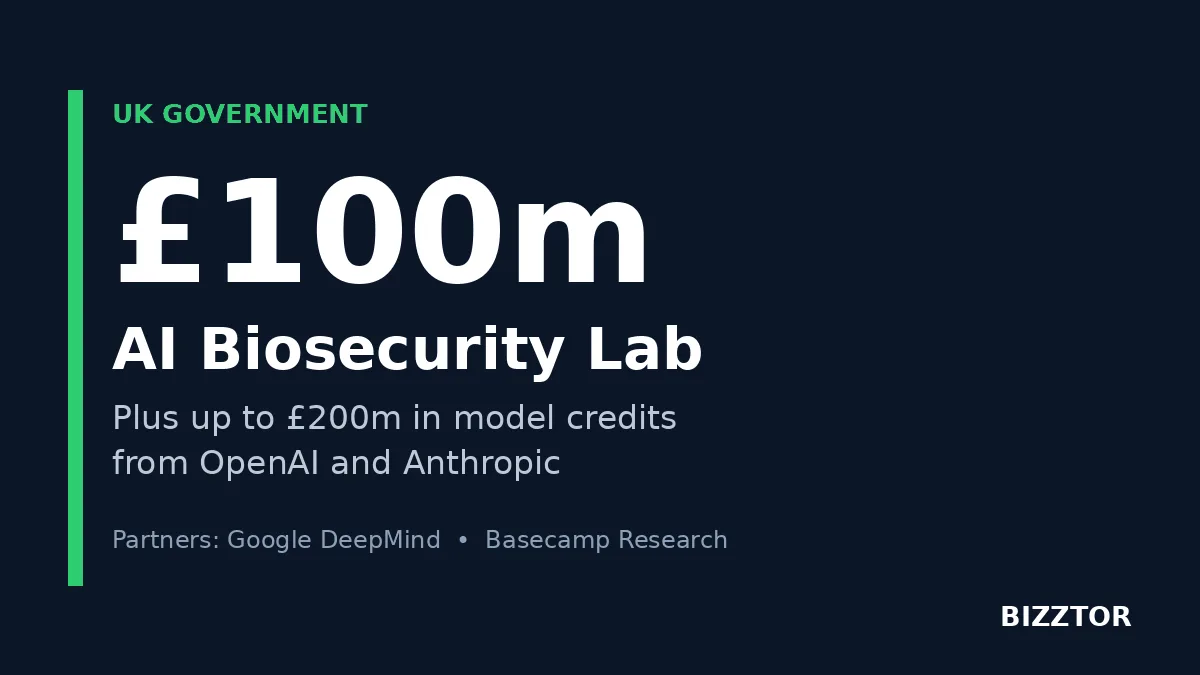
The UK government will put £100 million into a new AI Biosecurity Lab, with OpenAI and Anthropic adding up to £200 million in model credits, compute and technical support. The Cabinet Office published the announcement on GOV.UK just after midnight on Saturday 24 October, calling it the world's first dedicated AI biosecurity organisation.
The lab, known as AIBL, will use frontier AI models to spot biological threats earlier and speed up the discovery and testing of vaccines, treatments and other countermeasures. Google DeepMind and the London AI life sciences company Basecamp Research join as research partners.
Bloomberg put the headline figure at $134 million. It is one piece of a larger AI security package that the government says will total around £600 million when the Budget is delivered on 28 October.
Who is putting what into the AI Biosecurity Lab?
Only the government's £100 million is cash. Everything else is in kind.
OpenAI will provide £100 million in compute and model credits, plus trusted access to its most capable relevant models through its Rosalind Biodefense programme. OpenAI launched Rosalind on 29 May 2026 as a scheme to sponsor developers building defensive life sciences tools on GPT-Rosalind, its reasoning model for biology, according to Unite.AI.
Anthropic will provide up to £100 million in model credits, trusted model access and dedicated technical support. The wording differs: OpenAI's figure is flat, Anthropic's is a ceiling, and the announcement does not explain why.
Google DeepMind scientists and biosecurity specialists will work with the lab on research and may give it trusted access to Gemini and its specialised science models. Basecamp Research will contribute its AI-biology models and technical staff for what the government calls priority biosecurity challenges. Neither contribution has a published value.
How will the lab be run?
AIBL will be an independent non-profit, set up along the lines of the AI Security Institute. The government wants it to hire from industry and academia and to move at the pace of a frontier AI-bio company rather than a Whitehall department. A scientific advisory committee drawn from academia, industry and the third sector will oversee the science, with members to be named later.
The lab sits inside a new National AI Biosecurity Initiative that brings together the UK Health Security Agency, the Animal and Plant Health Agency and Dstl, the defence science laboratory at Porton Down. It will also work with the MHRA on preparing for health emergencies and on how AI-designed medicines should be regulated.
The announcement is silent on where the lab will be based, who will lead it and when it will open. The government also says it intends AIBL to take philanthropic money over time, so the £100 million is seed funding rather than a full budget.
What else is in the £600 million package?
The lab is the largest single line in a wider AI security announcement that the BBC reports will be set out in full at the Budget. Alongside it sits £120 million for the AI Security Institute, £130 million for AI-driven national cyber defence and a separate £65 million for developing countermeasures against new pathogens.
AI minister Kanishka Narayan told the BBC the lab would be "a major new global institution bringing together world-leading scientific expertise" to protect people from emerging biological threats. Narayan has had AISI in his portfolio since July, and the institute has already had a turbulent few months over access to unreleased frontier models.
What this means for UK founders
Basecamp Research is the detail worth noticing. A UK startup is named alongside three of the largest AI developers in the world, and its models will be used on national biosecurity work. That is a signal that the government is willing to put British AI-bio companies inside its security institutions rather than fund them at arm's length.
It also extends a pattern. The Sovereign AI Fund's backing for Augur and NVIDIA's $250 million compute pledge to UK safety research both routed resources to UK AI security work through partnerships rather than grants. AIBL does the same with biology.
For founders building in drug discovery, diagnostics or synthetic biology, the practical questions are who the lab will partner with and on what terms, and whether the £200 million in credits can flow to collaborators or stay inside AIBL. None of that is answered yet. The Budget on 28 October, which is also expected to carry the non-compete changes the AI sector lobbied for, should fill in some of it. The scientific advisory committee appointments will show the rest.